ASCA: The Student Org Operations Platform for Events, Moderation, and Automation
- Published on
- Scope
- Full-stack platform
- Focus
- Community operations
- Role
- System designer and developer
ASCA: The Student Org Operations Platform for Events, Moderation, and Automation
Most student organizations run on a heroic mix of spreadsheets, forms, Discord threads, and officer memory.
ASCA helps student communities run like they actually own software on purpose.
It brings event management, moderation, automation, support, and voting into one modular platform, so teams spend less time chasing process and more time running the organization.
Student org work looks simple until the club gets busy.
You are planning events, checking memberships, answering the same questions, handling moderation issues, and trying not to lose important context every time leadership changes.
That is the problem ASCA is built to solve.
In Plain English
Community operations happen
  -> ASCA routes the workflow
  -> officers get structure instead of chaos
  -> members get a smoother experience
ASCA is not one giant feature blob.
It is a platform made of focused modules that solve recurring operational pain.
What Makes It Different
Most club tooling starts as a one-off bot command or a cursed spreadsheet that slowly becomes everyone's problem.
ASCA goes one step further.
It turns those recurring tasks into reusable systems with clear workflows, shared data, and room to grow.
The goal was not "more tools." The goal was fewer operational headaches.
What ASCA Includes Today
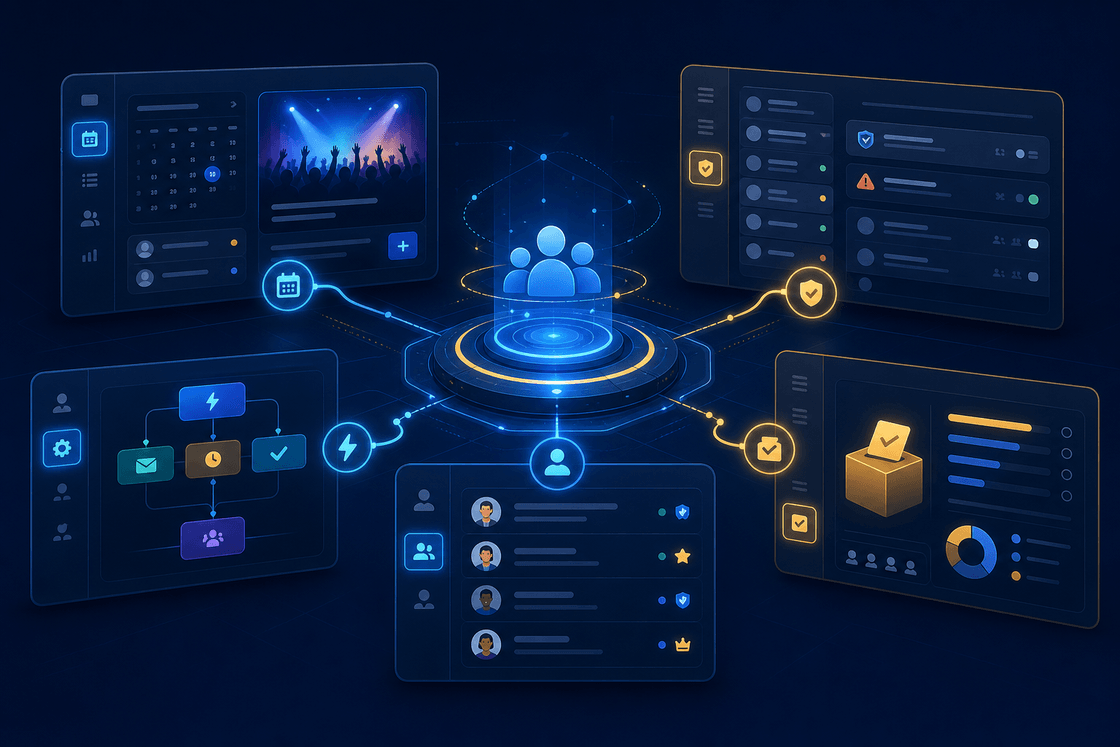
The platform is organized into a set of connected modules:
- EMMA for event registration, membership validation, and attendance tracking
- AMAR for automated moderation, logging, and enforcement support
- AURA for assistant-style responses to common community questions
- Macro for conversation-aware moderation and guidance
- Aaravos for structured nominations and secure voting flows
Each module handles a different operational job, but they fit into the same broader system instead of living as disconnected side projects.
Why That Matters
When communities grow, the hard part is rarely one specific feature.
The hard part is all the glue work:
- passing the same information between tools
- repeating the same admin steps every week
- rebuilding workflows every time officers graduate
- keeping policy, membership, and event records consistent
ASCA exists to make that glue work less miserable.
Technical Design
ASCA combines a Next.js interface with backend services, community integrations, and database-backed workflows.
The architecture is modular on purpose.
Different parts of the platform need to evolve at different speeds. Event tooling, moderation tooling, and support flows all have different product constraints, so forcing them into one giant monolith would make everything worse.
Key engineering priorities were:
- keeping workflows simple for non-technical officers
- making event-time operations dependable under live usage
- reducing repetitive administrative work
- preserving enough structure for long-term maintainability
Real-World Constraint: Student Leadership Turns Over
One of the most important design constraints was not technical at all.
Student organizations reset themselves constantly.
People graduate. Officers change. Institutional knowledge evaporates. The software has to survive that.
So the platform had to be understandable, teachable, and boring in the right places.
That is part of why the project matters to me. Good operations software is not just about features. It is about making continuity easier for the next team.
What Is Next
The current platform direction proves the modular model works.
Next, the interesting work is:
- tightening cross-module integrations
- improving officer-facing workflows
- reducing setup friction for new teams
- making more processes auditable and repeatable
The bigger vision is simple: student communities should be able to run on software that feels intentional, not improvised.
Final Thought
Clubs and student organizations do a surprising amount of real operational work.
ASCA is my attempt to give that work better software, so the humans can spend less time wrestling process and more time building community.