Incident Report: Docker Host Failure and Bot Infrastructure Disruption

- Published on
- Domain
- Infrastructure operations
- Focus
- Reliability engineering
- Role
- System architecture and operations
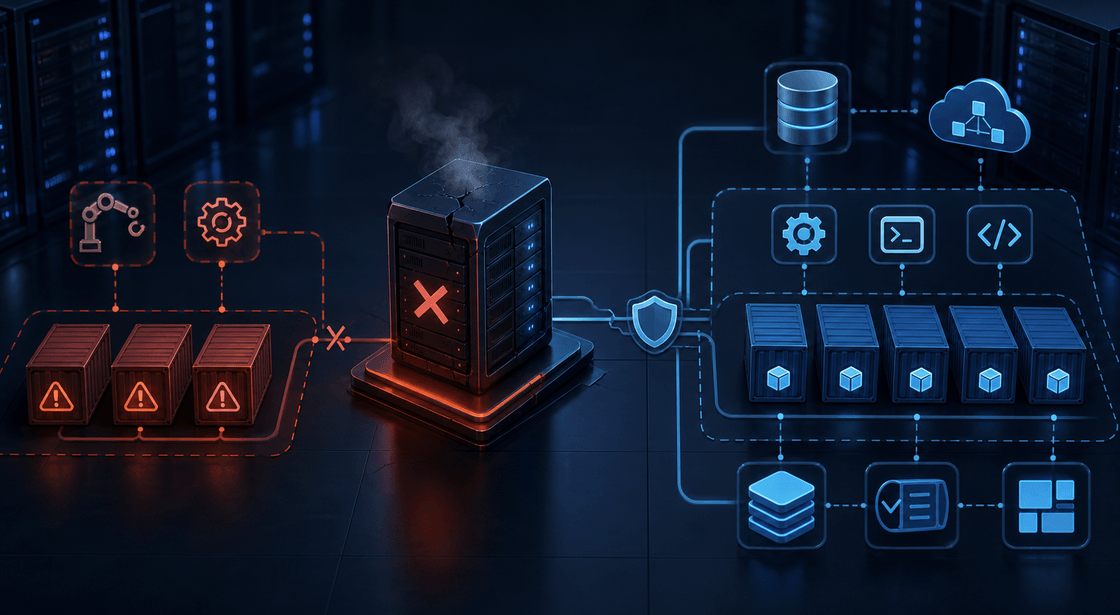
Incident Report: Docker Host Failure and Bot Infrastructure Disruption
On February 24, 2026 at 11:24 PM Oregon time, a hardware failure took down the physical server hosting the Docker environment for several community automation services. The bot stack went offline, but the rest of the platform stayed up.
The important detail is that the failure remained limited to the Docker host.
Disclosure: I participate in the IONOS Premium Agency Partner program. Some infrastructure referenced in this article may involve services obtained through that relationship. This disclosure is provided for transparency only and does not imply endorsement or responsibility for the events described.
What Happened
The immediate cause was a hard drive failure on the physical Docker host machine.
That server runs the Docker engine responsible for several containerized Discord bot services. When the drive failed:
- Discord bot containers went offline
- container orchestration stopped
- bot services could no longer connect to Discord
The failure was isolated to that host.
What Was Affected
The following services were temporarily unavailable:
- OAC Discord bots
- containerized automation services
- scheduled bot tasks
These all depended on the Docker runtime environment that failed.
What Was Not Affected
Because the architecture separates compute responsibilities, several important systems kept working:
- web services
- database servers
- API infrastructure
- web-based event registration
- data storage
The bots talk to the platform through the same API layer used by web applications. Since the API and database stack lived elsewhere, no data was lost and no database corruption occurred.
That architecture kept the outage limited in scope.
Infrastructure Overview
The Docker host failed, but the API and database stack did not. That is why the incident remained contained instead of becoming a broader platform outage.
Recovery
Once the hardware issue was identified, recovery focused on restoring the container environment:
- diagnose the failing storage device
- replace or repair the affected drive
- rebuild the Docker runtime environment
- restart containerized bot services
Estimated restoration time was about three hours from the start of the incident.
A Note About The Hardware
The failing machine had been part of my infrastructure for more than half a decade, and the hardware itself was much older than that, likely more than 25 years old.
While the outage was inconvenient, the system had already operated well beyond what would normally be considered a comfortable hardware lifespan.
Lessons Learned
The incident reinforced a few things:
- aging hardware should be replaced before failure becomes likely
- containerized services are easier to recover after host failures
- separating compute from persistent data meaningfully reduces risk
- clear system boundaries make incidents easier to contain
Closing Thought
Hardware failures are inevitable. What matters is whether the architecture keeps them contained.
In this case, the system separation did exactly that.