Incident Update: Storage Failure Investigation and Recovery Efforts

- Published on
- Domain
- Infrastructure operations
- Focus
- Incident response and recovery
- Role
- Infrastructure architecture and operations
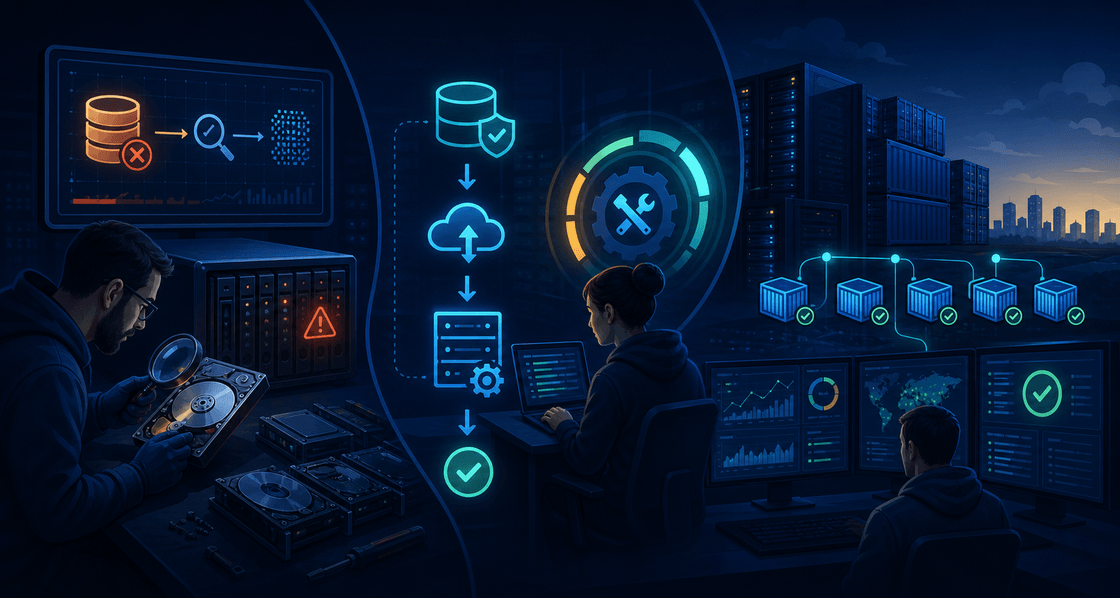
Incident Update: Storage Failure Investigation and Recovery Efforts
This update covers the ongoing recovery work after the Docker host storage incident affecting several continuous-runtime services used by community automation systems.
The original expectation was a relatively quick repair. The actual situation turned out to involve deeper hardware and filesystem damage, which extended the recovery timeline.
Disclosure: I participate in the IONOS Premium Agency Partner program. Some infrastructure referenced in this article may involve services obtained through that relationship. This disclosure is provided for transparency only and does not imply endorsement or responsibility for the events described.
Short Version
The incident started with a hard drive failure on the physical server hosting the Docker runtime environment.
Recovery then ran into additional storage and partition-level problems, which meant the process had to shift from normal restoration into safer forensic-style recovery work.
What Stayed Up
Because the infrastructure separates serverless systems from continuous runtime systems, several important services remained fully operational:
- serverless API services
- database infrastructure
- event registration systems
- automation APIs
- other serverless platform components
That separation kept the incident limited instead of becoming a wider platform failure.
What Stayed Down
The services still affected were the ones tied to the damaged continuous runtime host:
- Docker container services
- Discord automation bots
- webmail services
- auxiliary DNS services
- domain forwarding systems
- WordPress hosting instances
These services could not recover until the storage situation was understood and stabilized.
Why Recovery Slowed Down
The initial recovery attempt followed the normal path:
- repair or replace the failed drive
- rebuild the storage configuration
- restore the runtime environment
That did not work.
The system had been configured with RAID 1 mirroring, so the next step was trying to rebuild the array after replacing the failed drive. That rebuild also failed, and the remaining drive entered an error state.
At that point, the incident was no longer a routine hardware replacement and instead appeared to involve deeper filesystem or partition-level damage.
Rescue Mode and Analysis
To investigate safely, the server was booted into rescue mode.
That made it possible to inspect the affected storage directly without relying on the damaged runtime environment.
The key finding was that the partition table had become corrupted, which prevented the operating system from mounting the filesystem correctly.
Recovery Strategy
Because direct repair on a damaged disk can increase the risk of further data loss, the current strategy focused on safer recovery steps:
- clone the damaged drive
- preserve the original image
- attempt filesystem reconstruction from the clone
- recover container and service data where possible
That approach trades speed for caution, which was necessary under the circumstances.
Architecture Check
The broader infrastructure design still mattered a lot:
Because the API and database infrastructure were separate from the Docker host, critical data and core platform functionality remained safe while recovery work continued.
Current Status
At the time of this update, recovery work was focused on:
- cloning the corrupted drive
- analyzing filesystem damage
- recovering container data
- restoring continuous-runtime services
Further updates would follow once recovery advanced or services were restored.
Closing Thought
Redundancy helps, but it does not eliminate every failure mode.
What matters is having enough architectural separation that one failed system does not take the rest of the platform down with it.