AI Is Not the First Tool People Feared

- Published on
- Domain
- AI literacy
- Focus
- Technology history, labor, accessibility, and adaptation
AI Is Not the First Tool People Feared
Every major tool changes work.
That has always been true.
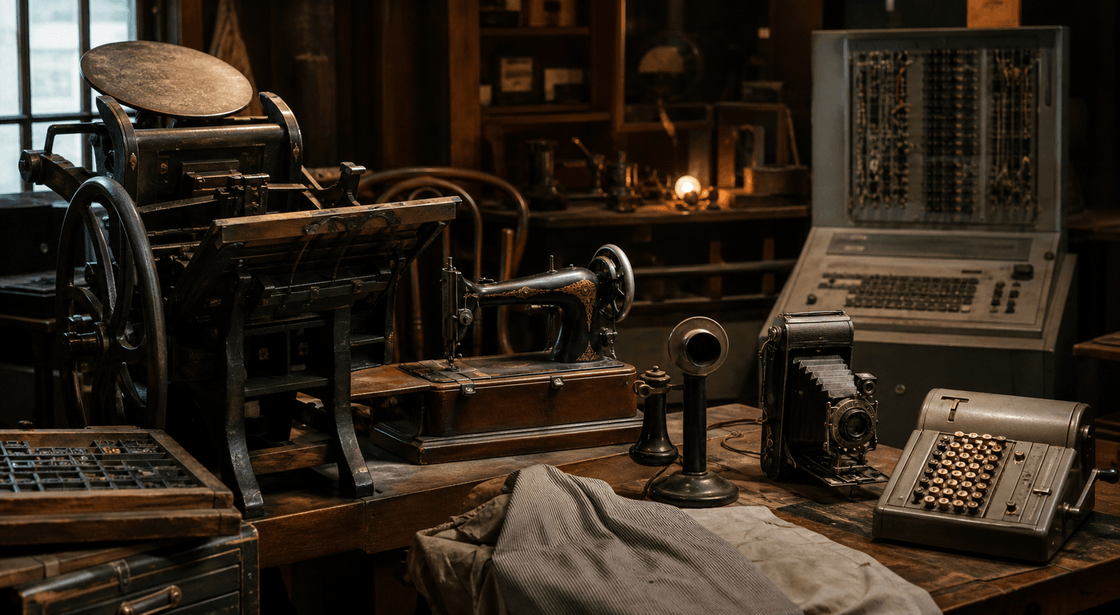
Machines changed farming. Printing changed books. Textile machinery changed clothing. Sewing machines changed garment work. Cameras changed portrait painting. Telephones changed communication. Cars changed streets. Elevators changed buildings. Calculators changed classrooms. Computers changed offices. The internet changed information. ATMs changed banking. Search engines changed how people find knowledge.
AI is part of that history.
It is powerful, disruptive, and worth criticizing. There are real concerns about labor, exploitation, copyright, misinformation, bias, surveillance, energy use, education, and corporate power. Those concerns should not be dismissed.
But treating AI as uniquely evil, or pretending society can simply reject it, ignores how technological progress has always worked.
The better question is not:
Should AI exist?
The better question is:
How do we use AI responsibly, fairly, and intelligently?
People have pushed back against disruptive tools before. Many tools that are now normal, useful, and even boring were once feared, restricted, mocked, or treated as threats to work, morality, education, safety, or social order.
That does not mean every new tool is automatically good.
It means fear alone is not enough of an argument.
History shows a repeated pattern:
- A new tool appears.
- People fear the jobs, skills, habits, or social order it may destroy.
- The tool causes real disruption.
- Society slowly adapts through new skills, rules, businesses, education, and expectations.
- The tool becomes normal.
- Later generations forget how controversial it once was.
AI is not the first time this has happened.
It will not be the last.
Fear of New Technology Is Not New
When a new tool appears, people often fear what it will replace.
That fear is not irrational. Technology does replace tasks. Sometimes it replaces entire jobs. The transition can be painful, especially for workers whose skills are suddenly less valued.
But history also shows that tools do not simply destroy human value. They change where human value is needed.
A machine may replace one repetitive task, but humans are still needed to design, operate, supervise, maintain, improve, regulate, and direct the system.
The work changes.
The skill expectations change.
The economy changes.
That is not always comfortable.
But it is not new.
The mistake is assuming that because a tool disrupts work, it must be rejected entirely. That argument has been made many times before. If society had followed it consistently, we would not have mass-produced books, cheap newspapers, ready-to-wear clothing, elevators, modern transportation, electric appliances, calculators, computers, search engines, or the internet.
Most people today do not want to give those things up.
That should make us more careful when people argue that AI is different only because it feels disruptive now.
Every disruptive tool feels uniquely threatening when people first encounter it.
Books Were Once Rare, Expensive, and Limited
Today, books are ordinary.
A person can buy a paperback, borrow from a library, download an ebook, read articles online, or search millions of pages instantly. That feels normal now.
It was not always normal.
Before mechanized printing, books were copied by hand or produced through much slower methods. That made books expensive and limited. Access to written knowledge was often concentrated among religious institutions, universities, scholars, wealthy patrons, and political elites.
The printing press changed that.
The printing press did not simply replace scribes. It changed who could access information. Britannica describes the printing press as the machine that transferred text and images from movable type to paper and notes that printing became mechanized in Europe in the fifteenth century. Britannica
Gutenberg’s press did not instantly put cheap books into every poor household. That would be too simple. But it started a massive shift. Printing made copying faster, made books more reproducible, and helped create a market where written material could spread far beyond the old manuscript culture.
Britannica describes Gutenberg’s printing press as a history-changing invention that made books widely accessible and helped create an information revolution. Britannica
That phrase matters: information revolution.
The printing press disrupted existing work, but it also changed civilization. It helped spread religious debate, scientific ideas, political arguments, education, literacy, and public discourse.
At the time, the disruption was real. Scribes, copyists, manuscript producers, and existing information gatekeepers faced a changed world. But from today’s perspective, most people would not say society should have rejected printing because it disrupted manuscript labor.
We like the result.
We like cheap books.
We like libraries.
We like mass education.
We like being able to read without needing to be rich.
That is the point.
A technology can disrupt old labor systems and still expand access in ways that later generations consider obviously good.
Newspapers Also Became Accessible Through Cheaper Printing
Books were not the only thing changed by printing.
Newspapers changed too.
Today, people expect news to be cheap, fast, and widely available. But newspapers were not always priced for ordinary working people. In the United States, the penny press changed that.
Britannica explains that Benjamin Day’s New York Sun, launched in 1833, sold for one cent at a time when standard newspapers often cost six cents and were out of reach for the average working person. Britannica
That was not just a business model change.
It changed who news was for.
The penny press made newspapers more accessible to working and middle-class readers. It shifted journalism toward a broader public audience. It changed what newspapers covered, how they were funded, and who could participate in public information culture.
Was penny press journalism perfect?
No.
It could be sensational, messy, commercial, and imperfect. But it also helped democratize access to news. EBSCO’s historical summary describes penny papers as democratizing news consumption and enabling common citizens to receive information directly. EBSCO
That is another familiar pattern.
A technology reduces cost.
A product that was once harder to access becomes more widely available.
The quality is uneven at first.
Society argues about what the change means.
Eventually, people take the new access for granted.
That pattern matters for AI. AI may make certain kinds of writing, summarization, translation, tutoring, coding help, design drafting, and research assistance far more accessible. Some of the output will be bad. Some uses will be abusive. Some business models will be exploitative.
But the possibility of bad use does not erase the accessibility gain.
The printing press gave us both cheap books and cheap misinformation.
The answer was not to ban printing.
The answer was to build literacy, journalism standards, libraries, education, laws, and critical reading skills.
AI needs the same kind of response.
Textile Machines Were Resisted, but Machine-Made Clothing Became Normal
Textile machinery is one of the clearest examples of technological disruption.
Before industrial textile production, making cloth and clothing required enormous human labor. Skilled workers spun, wove, cut, sewed, finished, and repaired fabric by hand or with simpler tools.
Machines changed that.
The change was not gentle.
The Luddites, organized groups of English textile workers in the early nineteenth century, famously destroyed machinery that they believed threatened their livelihoods. Britannica describes Luddites as English handicraftsmen who rioted for the destruction of textile machinery that was displacing them. Britannica
The National Archives similarly describes workers sending threatening letters, breaking into factories, and destroying new machines such as wide weaving frames. The National Archives
It is important not to caricature them. The Luddites were not simply stupid people who hated progress. Many were skilled workers responding to real economic harm, wage pressure, and loss of control over their craft. Some historians argue that their anger was directed less at machines themselves and more at the way factory owners used machines to undermine skilled labor and working conditions.
That nuance matters for AI too.
Workers are not wrong to worry when companies use automation to cut pay, reduce quality, avoid accountability, or weaken bargaining power.
But textile machinery also made fabric and clothing much more available. Cornell University’s textile history exhibit describes industrial textile machinery as creating streamlined production, consistent products, and new avenues for affordable clothing. Cornell University Library
Britannica notes that mass production lowered the cost of tools, clothes, and household items for ordinary people. Britannica
Today, most people do not expect every shirt, sock, blanket, towel, or jacket to be handmade from scratch. Machine-made clothing is normal because machines made clothing dramatically more accessible.
People still value handmade clothing. Tailoring, couture, craft, repair, and design still matter. But basic clothing is no longer limited to people who can afford enormous amounts of skilled manual labor.
That is a good thing.
The lesson is not that textile industrialization was painless or morally perfect. It was not. It came with harsh factory conditions, exploitation, and social upheaval.
The lesson is that the correct response was not to reject machines forever.
The correct response was to build a society that could use machines while also fighting for labor rights, safety standards, wages, reasonable hours, and human dignity.
That is exactly the kind of argument we should make about AI.
Do not blindly worship the machine.
Do not blindly reject the machine.
Fight over how the machine is used.
Sewing Machines Were Also Attacked
The sewing machine is another example people can relate to.
Today, sewing machines are ordinary household and industrial tools. Nobody sees them as a shocking threat to civilization. A sewing machine is just a useful device.
But the early history was not calm.
Wired recounts that French tailor Barthelemy Thimonnier patented a sewing machine in 1830 and planned to use it to mass-produce uniforms for the French army. In 1831, around 200 tailors rioted, ransacked his factory, destroyed dozens of sewing machines, and forced him to flee. Wired
That story sounds very familiar.
A machine appears.
Skilled workers fear replacement.
Workers attack the machine.
The machine still spreads.
The world changes.
Today, sewing machines are everywhere. They support home sewing, repair, tailoring, fashion, manufacturing, quilting, cosplay, upholstery, prototyping, and small businesses. They did not eliminate clothing design or textile creativity. They changed what could be produced and who could produce it.
A person with a sewing machine can do work that would take far longer by hand.
That does not make the person less creative.
It gives the person a better tool.
AI can be understood the same way. A writing assistant does not automatically make someone a thinker. A code assistant does not automatically make someone an engineer. An image generator does not automatically make someone a designer.
But for someone who understands what they are doing, the tool can multiply their ability.
That is why the real question is not whether the tool exists.
The real question is whether the user has judgment.
Photography Was Feared as a Threat to Art
Photography also disrupted creative work.
Before photography, portrait painters had a practical role that went beyond artistic expression: they preserved likenesses. If a family, leader, businessperson, or institution wanted a realistic image, painting was one of the main options.
Photography changed that.
Suddenly, a machine could capture visual reality faster and more cheaply than a painter. That raised obvious fears about what would happen to painters and traditional art.
But photography did not end art.
It changed art.
As photography became better at capturing realistic likenesses, painters explored other directions: impressionism, abstraction, symbolism, expressionism, surrealism, and many other movements. The Museum of Arts and Sciences describes how, as demand for exact likenesses diminished, painters explored new ground and emphasized what was unique to painting, including brushwork and expression. Museum of Arts and Sciences
Today, nobody says photography should not exist because it disrupted portrait painting.
We like photography.
We like being able to take family photos.
We like photojournalism.
We like scientific imaging.
We like medical imaging.
We like having a camera in our phones.
We like documenting life without hiring a painter every time.
At the same time, painting still exists. It did not vanish. It became less necessary for one function and more open to others.
That is a powerful comparison for AI art.
AI image generation may disrupt parts of illustration, stock art, concept drafting, and commercial design. That matters. Artists have valid concerns about training data, credit, compensation, market flooding, and misuse.
But the existence of a new image-making tool does not mean all human art becomes meaningless. Photography did not destroy painting. It changed what painting was for.
AI will likely do the same to some creative fields.
The right response is not panic.
The right response is to define ethics, rights, credit, compensation, disclosure, professional standards, and new forms of creative value.
Cars Were Treated as Dangerous Intruders
Cars are now symbols of independence and convenience.
People use them to commute, travel, shop, visit family, run businesses, deliver goods, and access places that would otherwise be difficult to reach.
But early cars were not universally welcomed.
They were noisy, dangerous, unfamiliar, and disruptive to streets designed around pedestrians, horses, carts, and streetcars. In Britain, early motor vehicles faced severe restrictions under laws often associated with the “Red Flag Act.” The Open University describes the Locomotive Act 1865 as requiring unusual restrictions that dealt a crushing blow to the early automobile industry. Open University
The University of Chicago Press excerpt on automobile history notes that the law limited road locomotives to very low speeds and required a person on foot carrying a red flag ahead of the vehicle. University of Chicago Press
That sounds absurd now.
A car that must follow a walking person with a flag loses much of the point of being a car.
But at the time, people were reacting to real fears: explosions, frightened horses, road danger, and disruption to existing transportation systems.
Even in American cities, the automobile was not always seen as freedom. MIT Press notes that to many urban Americans in the 1920s, cars and drivers were seen as tyrants that deprived others of freedom in the streets. MIT Press Reader
That history should make us humble.
Today, many people cannot imagine modern life without cars, trucks, buses, ambulances, delivery vehicles, taxis, rideshare, road trips, or supply chains. Yet cars were once frightening intruders.
Cars also caused real harm: crashes, pollution, sprawl, oil dependence, and pedestrian danger. The answer was not simply “cars good” or “cars bad.” Society developed licensing, traffic laws, road design, insurance, safety standards, speed limits, seatbelts, emissions rules, crash testing, and public transportation debates.
That is the mature pattern.
Adopt the useful tool.
Regulate the harm.
Do not pretend the tool can be erased from history.
AI needs the same approach.
Telephones Were Once Socially Suspicious
The telephone is another technology people now take for granted.
A person can call family, contact emergency services, talk to a doctor, coordinate work, run a business, order food, join a meeting, or maintain a long-distance relationship. Phones are so normal that many people feel anxious without them.
But telephones also caused social anxiety when they appeared.
Smithsonian Magazine describes how skeptics worried about how the telephone might affect people’s interactions. Smithsonian Magazine
That sounds familiar because every communication technology triggers similar worries.
Letters were different from face-to-face speech.
Telephones were different from letters.
Email was different from phone calls.
Texting was different from email.
Social media was different from texting.
AI-generated communication is now different again.
Some concerns are valid. Communication tools can change attention, privacy, etiquette, authenticity, relationships, and work expectations.
But most people would not argue that the telephone should have been rejected entirely because it changed communication norms.
We like being able to call 911.
We like being able to call family across the country.
We like being able to coordinate emergencies.
We like being able to run businesses without physically traveling for every conversation.
The telephone changed society because it made communication more accessible.
AI may do something similar for certain kinds of communication: translation, drafting, summarizing, accessibility, tutoring, and assisting people who struggle with writing. That does not mean every use is good. It means the tool needs norms.
The question is not whether communication should ever be assisted by machines.
It already is.
The question is when assistance is helpful, when it is deceptive, and when disclosure matters.
Electricity Was Feared Before It Became Invisible Infrastructure
Electricity is now invisible infrastructure.
Most people do not think about it unless it stops working. Lights, refrigerators, computers, hospitals, elevators, heating, cooling, factories, networks, and water systems all depend on electricity.
But electricity was once strange, frightening, and controversial.
There were public fears about electrical wires, electrocution, fires, and the safety of new systems. The public debate over electrical power was not just technical; it was cultural. Historical writing on nineteenth-century electricity describes how public ideas often gravitated toward fear, especially around dangerous wires and accidents. Shells and Pebbles
There was also a famous “war of the currents” between competing electrical systems and business interests. People were not simply deciding whether electricity was useful; they were deciding which infrastructure, standards, and companies would shape the future.
Today, electricity is so normal that people forget how much society had to build around it: wiring codes, electrical standards, utility regulation, safety inspections, circuit breakers, grounding, licensing, and public infrastructure.
Again, this is the pattern.
A powerful technology appears.
It creates new possibilities and new dangers.
People fear it.
Society argues.
Standards emerge.
The tool becomes normal.
AI may need the same kind of social infrastructure: transparency rules, safety standards, privacy protections, liability models, education, professional norms, disclosure expectations, and limits in high-risk areas.
That is very different from saying “AI should not exist.”
Elevators Lost Operators, but Society Gained Vertical Cities
Elevators are one of the clearest examples of a job that largely disappeared.
There used to be elevator operators. They controlled elevator movement, opened and closed doors, and helped passengers move through buildings.
Then push-button and automatic elevator systems made it possible for passengers to operate elevators themselves. Elevator World describes push-button elevator systems being developed in the late nineteenth century to enable operation without a trained attendant. Elevator World
Today, elevator operators are rare.
But the elevator did not make buildings worse.
It made vertical cities easier to operate.
It helped make high-rise buildings practical for ordinary use.
The work shifted toward installation, inspection, maintenance, engineering, emergency systems, building operations, and safety regulations.
A person no longer needed to stand inside every elevator all day.
That is not a loss of human purpose.
That is a change in where human work is most useful.
AI will likely create similar shifts. Some tasks that once required constant human involvement may become automated. That does not mean there is no need for humans. It means human work moves toward the parts that require responsibility, maintenance, review, empathy, judgment, strategy, and adaptation.
Household Appliances Changed Domestic Labor
Washing machines, vacuum cleaners, refrigerators, dishwashers, and electric stoves are now normal household tools.
People rarely describe them as “job-stealing machines,” but they absolutely changed labor.
Before modern household appliances, domestic work required enormous time and physical effort. Laundry alone could involve hauling water, heating water, scrubbing, wringing, drying, and ironing. Food storage was limited. Cleaning took more time. Meal preparation required more manual labor.
Household appliances changed that world.
Penn Today summarizes research showing that in 1900, the average household spent 58 hours per week on housework, including meal preparation, laundry, and cleaning; by 1975, that figure had dropped to 18 hours. Penn Today
That did not mean the social effects were simple. Domestic workers lost jobs. Gender expectations changed unevenly. Some household labor was not eliminated so much as reorganized. The New-York Historical Society notes that electrical appliances made domestic chores easier but also had negative impacts, including unemployment among domestic workers and changing expectations for women at home. Women & the American Story
That nuance matters.
Technology can improve life overall while still creating real losses for specific workers.
But most people today do not want to give up washing machines because they disrupted laundry work. Most people do not want to return to a world where ordinary household chores consume most of the week.
We like the accessibility.
We like the saved time.
We like that more people can maintain a home without hiring servants or spending endless hours on manual labor.
That is exactly the kind of accessibility argument people often ignore in AI debates.
AI may reduce the cost of certain kinds of assistance: writing help, tutoring, translation, coding support, document summarization, visual drafting, accessibility tools, and administrative support.
That does not mean all AI use is good.
It means the accessibility gain is real.
Refrigeration Changed Food Access
Refrigeration is another technology people take for granted.
Today, people buy milk, meat, vegetables, frozen food, leftovers, medicine, and vaccines with the assumption that cold storage exists. Grocery stores, restaurants, hospitals, pharmacies, farms, and global supply chains all depend on refrigeration.
But mechanical refrigeration changed society dramatically.
The Smithsonian’s National Museum of American History describes electric refrigeration as something that reshaped how Americans purchased, prepared, and stored food when it took off in the 1930s, and notes that refrigerators continue to play a central role in daily life. Smithsonian National Museum of American History
Refrigeration also changed food geography. USDA describes Frederick McKinley Jones’s truck refrigeration system as an invention that allowed perishable foods to be transported over longer distances. USDA
This created huge benefits: safer food storage, less spoilage, more flexible diets, longer-distance food distribution, and better medical storage.
But there was also suspicion. Historical writing on mechanical refrigeration notes that consumers initially worried about cold storage being used to manipulate supply and prices. Engelsberg Ideas
Again, the pattern repeats.
A new tool creates real benefits.
It also creates new risks and new power.
Society has to build trust, rules, standards, and supply chains around it.
Nobody today argues that refrigeration should have been rejected because it changed food markets. We regulate it. We inspect it. We build standards around it. We depend on it.
AI should be treated the same way: not blind acceptance, not blind rejection, but responsible integration.
Calculators Were Feared in Classrooms
Calculators are another relatable example.
Today, calculators are normal. Students use them. Engineers use them. Cashiers use them. Scientists use them. Phones include them. Nobody thinks using a calculator for arithmetic automatically makes someone unintelligent.
But calculators were controversial in education.
A historical analysis of calculator use in education notes that reactions from teachers, principals, researchers, and curriculum developers shaped calculator policies. ERIC
Other education discussions recorded the concern directly: some argued that students would not learn basic facts if calculators were allowed and that schools should ban calculators to preserve arithmetic skills. Ohio State University Knowledge Bank
That concern sounds almost identical to today’s AI debate.
People worried students would stop thinking.
People worried basic skills would disappear.
People worried the tool would become a shortcut.
Those concerns were not entirely wrong. A student who uses a calculator without understanding arithmetic can still get nonsense. If they enter the wrong numbers, use the wrong operation, or misunderstand the problem, the calculator will not save them.
But calculators also let students work on more complex problems. They reduce repetitive computation. They allow more focus on modeling, reasoning, checking, estimation, and interpretation.
That is the correct lesson for AI.
A calculator does not replace mathematical understanding.
AI should not replace thinking.
But a calculator can help someone who understands the problem work faster.
AI can do the same.
Computers Changed Office Work
Computers also caused fear.
They automated calculations, typing, filing, data storage, communication, design, publishing, accounting, and administration. Many tasks that once required specialized clerical labor became faster or disappeared.
But computers did not eliminate office work.
They changed what office work meant.
A modern office worker is expected to use email, spreadsheets, databases, document editors, search tools, project management systems, and communication platforms. The baseline skill level rose.
That can feel unfair to someone who does not want to learn new tools. But it also means one person can do work that previously required many more manual steps.
AI is likely to follow the same pattern.
The people who benefit most will not be the people who blindly let AI do everything.
The people who benefit most will be the people who understand their field and use AI to move faster.
That is the important distinction.
AI does not reward ignorance in the long run.
It rewards people who can combine domain knowledge with better tools.
The Internet Was Also Treated as Dangerous and Corrupting
The internet is now basic infrastructure.
People use it for banking, school, work, maps, shopping, research, entertainment, healthcare, community, activism, software, government services, and emergency communication.
But the internet also triggered fear.
Some fears were justified: scams, privacy loss, misinformation, harassment, piracy, exploitation, and harmful content are real problems.
Other fears became moral panic.
A 2020 paper in Perspectives on Psychological Science describes a recurring cycle of technology panics, where new technologies trigger public concern until the panic fades, deteriorates, or is replaced by a new one. PMC
That cycle matters because AI is now going through the same process.
People are worried AI will ruin education, destroy jobs, eliminate creativity, flood the internet with low-quality content, and make people dependent on machines. Some of those worries point to real risks. But the shape of the panic is familiar.
The internet did not become safe because people ignored the problems.
It became useful because society built tools, norms, laws, filters, platforms, schools, cybersecurity practices, and digital literacy around it.
The internet is still messy.
But most people do not want to abandon it.
They want it to be safer, better regulated, more reliable, and more useful.
That is the same position we should take with AI.
Search Engines Changed Knowledge Work
Search engines are another AI-like example people now take for granted.
Before search engines, finding information often required libraries, indexes, catalogs, subject experts, phone calls, printed directories, or simply knowing where to look. Search engines made information retrieval dramatically faster.
This changed work.
It changed journalism, research, education, marketing, shopping, travel, software development, and everyday problem-solving.
It also created problems: search ranking manipulation, misinformation, SEO spam, advertising incentives, privacy issues, and overreliance on quick answers.
But most people do not want to return to a world without search engines.
They want better search results.
They want trustworthy sources.
They want transparency.
They want media literacy.
They want stronger privacy protections.
That is another useful model for AI.
The answer to search engine problems was not “nobody should search.”
The answer was learning how to search well, evaluate sources, recognize bad results, and build better systems.
The answer to AI problems should not be “nobody should use AI.”
The answer should be learning how to use AI well, verify outputs, recognize failure modes, and build better rules.
ATMs Did Not End Banking Work
ATMs are a classic example because the fear was obvious: if machines can dispense cash, what happens to bank tellers?
People assumed bank tellers would disappear.
But economist James Bessen explained that ATMs reduced the number of tellers needed per branch, which made branches cheaper to operate. Banks then opened more branches, and teller work shifted instead of simply disappearing. International Monetary Fund
The machine took over a repetitive transaction.
Human workers moved toward customer service, account support, sales, and more complex banking needs.
This does not mean no jobs changed. They absolutely did.
It does not mean every worker benefited equally. They did not.
But it shows why the simple argument “machine does task, therefore humans disappear” is often too shallow.
Machines often replace tasks, not all human value.
AI may follow the same pattern in many fields. It may take over repetitive drafting, summarizing, formatting, classification, simple coding, basic customer support, and routine analysis. But that does not automatically mean humans are useless.
It means humans need to move toward judgment, context, relationship-building, accountability, strategy, creativity, and oversight.
Farming Mechanization Changed Food Production
Agricultural mechanization is one of the biggest examples of machines changing labor.
Before tractors and mechanized equipment, farming required far more human and animal labor. Mechanization changed the scale, speed, and productivity of agriculture.
The National Academy of Engineering describes tractors as significantly accelerating agricultural productivity and output. National Academy of Engineering
USDA data on global agricultural productivity shows that from 1961 to 2020, global agricultural output increased nearly fourfold, agricultural output per capita increased, and food prices adjusted for inflation declined compared with overall prices, making global diets more affordable and diverse. USDA Economic Research Service
Mechanization also displaced labor and changed rural economies. That matters. But most people today do not want to return to a world where food production depends entirely on manual labor and animal power.
We like abundant food.
We like lower food prices.
We like not needing most of the population to work in agriculture just to survive.
That is another example of a hard transition producing broad accessibility gains.
AI may do something similar for knowledge labor. It may reduce the cost of certain services, summaries, drafts, tutoring, translations, and technical assistance.
The transition will be uneven.
The benefits will not distribute themselves automatically.
But the accessibility gain should not be ignored.
Automation Often Replaces Tasks Before It Replaces Human Value
A job is not one thing.
Most jobs are bundles of tasks.
A teacher explains concepts, grades assignments, gives feedback, manages classrooms, supports students, designs lessons, communicates with families, and adapts to different learning needs.
A programmer writes code, reads code, designs systems, debugs, tests, reviews requirements, maintains infrastructure, communicates with users, and makes tradeoffs.
A doctor diagnoses, communicates, reviews evidence, performs procedures, monitors patients, coordinates care, and makes decisions under uncertainty.
A designer researches users, explores visuals, understands constraints, communicates meaning, and makes taste-based decisions.
AI may automate parts of these jobs. It may draft, summarize, classify, search, suggest, or generate.
But that does not mean the entire job disappears.
The more repetitive and isolated a task is, the easier it is to automate. The more a task depends on context, accountability, trust, ethics, physical presence, human relationship, or professional judgment, the harder it is to fully automate responsibly.
This is why people should not frame AI as simply “job replacement” or “no job replacement.”
The more accurate question is:
Which tasks are changing, and what human skills become more important because of that change?
Charlie’s Father and the Machine
A simple fictional example appears in Charlie and the Chocolate Factory.
In the 2005 film version, Charlie’s father loses his toothpaste factory job after automation replaces his role, but he is later rehired as a technician maintaining the machine. Wikipedia
It is fiction, but it captures a real economic pattern.
Technology often replaces tasks before it replaces human value.
The person who only performs the old repetitive task is vulnerable.
The person who understands the system, maintains the system, improves the system, or applies judgment around the system becomes more valuable.
That does not mean the transition is easy.
It means adaptation matters.
It also means society should help people adapt instead of pretending change can be stopped forever.
“Companies Will Just Keep the Profit” Is a Real Concern, but Not the Whole Story
A common argument against automation is that it does not help ordinary people because companies will simply keep the extra profit.
This concern should not be dismissed.
Companies often adopt technology because it saves money or increases output. They may capture much of the benefit first. Some may use automation to cut labor costs without sharing the gains fairly. Some may use AI to deskill workers, monitor workers, replace workers, or flood markets with low-quality output.
Those criticisms are valid.
But it is historically weak to argue that machines only enrich companies and never lower costs or improve access.
Books became more available after mechanized printing.
Newspapers became more accessible through the penny press.
Clothing became more affordable through textile machinery and industrial production.
Sewing machines made garment production and repair faster.
Photography made portrait and documentary images more accessible.
Cars expanded mobility.
Telephones made long-distance communication ordinary.
Electricity powered homes, hospitals, factories, and communication systems.
Elevators made tall buildings practical.
Household appliances reduced some forms of domestic labor.
Refrigeration changed food access and storage.
Calculators reduced repetitive arithmetic.
Computers changed office productivity.
Search engines made information retrieval faster.
ATMs made banking more convenient.
Agricultural mechanization increased food productivity.
That does not mean the benefits are distributed automatically.
They are not.
That does not mean every worker benefits immediately.
They do not.
That does not mean companies always act fairly.
They do not.
The real issue is distribution.
Who owns the tool? Who controls the tool? Who benefits from the productivity gain? Are there competitive markets? Are workers protected? Are consumers protected? Are there education pathways? Are there safety rules? Are there accountability systems?
The better argument is not:
Automation is always good.
The better argument is:
Automation creates power. Society has to decide how that power is shared.
Rejecting AI Does Not Protect Workers Forever
Completely rejecting AI may feel morally clean, but it is not a realistic long-term strategy.
If one person refuses to use a productivity tool, someone else may use it.
If one company refuses to automate, another company may automate and become faster.
If one country refuses to develop a technology, another country may continue.
That does not mean everyone should recklessly adopt every new tool.
It does not mean harmful AI uses should be tolerated.
It does not mean companies should be allowed to exploit workers or ignore artists, writers, users, and communities.
It means refusal alone is not protection.
The stronger position is responsible adoption: use the tool, understand the risks, regulate harmful uses, protect workers, compensate fairly, teach people how to adapt, and hold organizations accountable.
A society that refuses to learn new tools does not preserve itself.
It falls behind.
Continuous Education Is Not Optional
Some people respond to AI by saying:
So now everyone has to learn new skills?
Yes.
That has always been part of a healthy profession.
Doctors cannot rely forever on what they learned decades ago. Medical knowledge changes. Treatments change. Risks change. In Oregon, for example, the Oregon Medical Board says licensees must meet continuing education requirements and describes ongoing competence, continuous quality improvement, and lifelong learning as part of protecting the public. Oregon Medical Board
This is not unique to medicine.
Software is the same. Old coding habits can become insecure. Old libraries become unsupported. Old assumptions break. New attacks appear. OWASP publishes secure coding practices because software security requires intentional, current, and informed development practices. OWASP
A programmer who refuses to keep learning eventually becomes dangerous to the systems they maintain.
Teachers, engineers, doctors, lawyers, pilots, accountants, scientists, designers, technicians, and managers all need to keep learning because the world does not stop changing.
This is not unfair.
This is progress.
Continuous education is not punishment. It is how professions remain safe, useful, and trustworthy.
Nobody wants a doctor using outdated medical knowledge.
Nobody wants an engineer ignoring modern safety standards.
Nobody wants a programmer writing insecure code because they refused to learn current practices.
Nobody wants a pilot ignoring updated procedures.
Nobody wants a teacher using outdated information forever.
If society wants better outcomes, people need to keep learning.
AI does not create that obligation.
AI makes it more visible.
If You Stop Learning, Someone Else Keeps Going
If a field stops learning, it does not preserve itself. It falls behind.
History is full of examples where one group invented something, another group continued developing it, and the advantage moved.
Gunpowder is one example. Britannica describes black powder as originating in China and later spreading west, while European military development turned gunpowder into increasingly significant firearms and artillery systems. Britannica
The lesson is not that one culture was better than another.
The lesson is that invention alone is not enough.
Progress requires continued development, adaptation, application, and improvement.
The same is true with AI.
Having access to AI is not enough.
Refusing AI is not enough.
Blindly trusting AI is not enough.
People need to learn how it works, what it can do, what it cannot do, what risks it creates, and how to use it responsibly.
Anti-AI Criticism Should Be Better, Not Louder
There are valid reasons to criticize AI.
People should criticize AI systems that produce misinformation.
People should criticize companies that use AI to exploit workers.
People should criticize irresponsible data use.
People should criticize AI-generated spam.
People should criticize low-quality content flooding the internet.
People should criticize biased or unsafe systems.
People should criticize people who submit AI-generated work they do not understand.
People should criticize organizations that use AI to avoid accountability.
Those are real issues.
But criticism becomes weaker when it turns into absolute rejection.
Saying “AI is bad” is too broad. It fails to distinguish between different tools, different uses, different risks, and different levels of responsibility.
Using AI to summarize meeting notes is not the same as using AI to deny someone a loan.
Using AI to brainstorm article titles is not the same as using AI to generate fake evidence.
Using AI to help a student understand a concept is not the same as using AI to cheat.
Using AI to draft code that a programmer reviews and tests is not the same as deploying unknown code blindly.
Good criticism needs precision.
The problem is not that AI exists.
The problem is irresponsible use.
The Correct Response Is Not Blind Hype or Blind Rejection
There are two bad reactions to AI.
The first bad reaction is blind hype:
AI can do everything. I do not need to learn anymore.
That is wrong.
The second bad reaction is blind rejection:
AI is bad. Nobody should use it.
That is also wrong.
The responsible position is more mature:
AI should be used, but not blindly.
AI should be criticized, but not irrationally rejected.
AI should improve productivity, but not excuse exploitation.
AI should lower barriers, but not remove responsibility.
AI should help people learn, not give them permission to stop learning.
AI should be regulated where it can harm people.
AI should be questioned where it makes claims.
AI should be tested where it produces systems.
AI should be disclosed where transparency matters.
AI should be rejected in uses where it is unsafe, unfair, or inappropriate.
But AI as a category should not be treated as uniquely forbidden simply because it changes work.
Every major tool changed work.
The question is whether society handles the change responsibly.
AI Is Another Chapter in the History of Tools
AI is not the first technology to change work.
It will not be the last.
The printing press changed books.
The penny press changed news.
Textile machinery changed clothing.
Sewing machines changed garment work.
Photography changed visual culture.
Cars changed transportation.
Telephones changed communication.
Electricity changed infrastructure.
Elevators changed buildings.
Household appliances changed domestic labor.
Refrigeration changed food access.
Calculators changed classrooms.
Computers changed offices.
The internet changed information.
Search engines changed research.
ATMs changed banking.
Agricultural mechanization changed food production.
People feared, resisted, restricted, criticized, or fought many of these tools.
Now people take most of them for granted.
That does not mean every new tool is good.
It means disruption alone is not enough reason to reject a tool.
The question is not whether change will happen.
The question is whether people will respond with panic, laziness, or responsibility.
The worst future is not simply a future where people use AI.
The worst future is a future where people use AI without understanding it, companies use AI without accountability, and critics reject AI without offering a realistic path forward.
The better future is one where people learn the tool, question the tool, regulate the tool, and use the tool to make better things.
AI is not the end of human value.
It is a test of whether humans are willing to keep learning.